
Gaelic football betting odds: who prices the action, who carries the action, who drains the book
 Available in US
Gaelic football lands somewhere unusual on a British betting slip. The sport is built around a scoring split that nobody else uses — three points for a ball under the crossbar, one for a ball over it — and the fixtures come thick between the provincial championships in May and the All-Ireland final in July, then thin out for the rest of the year. A bookmaker that takes the sport seriously has to price two outcomes where the scoreboard tells the story, hand the bettor a sensible in-running line, and offer the accumulator shapes the Championship lend themselves to, all without an English-style league schedule to anchor the form. The page that follows weighs ten operators on that work and explains how a price is built in the first place, so the comparison reads as a judgement about what each bookmaker is doing rather than a description of who they are.

Current as of October 30, 2026 against the Gambling Commission’s public register.
How to approach Gaelic football betting without falling for the marketing
Every bookmaker’s homepage says the same thing: the best odds, the deepest markets, prices you cannot beat. None of that is information. What a bettor can actually use is a small set of questions, and the marketing copy has nothing to do with any of them.
The first is whether the operator is licensed to take a bet from a customer in Great Britain. The licence is not a marketing line — it is the legal permission to operate, the registration with GAMSTOP, the route to the Commission’s complaints procedure, and the duty on the operator to check identity before the first deposit. The book’s homepage will not help here: the test is the Commission’s public register, searchable by name, licence number or domain, and an operator off the register is not licensed to take a GB bet whatever its footer says.
The second is the shape of the price. Decimal odds of 1.90 on each side of a two-way market are not the same bookmaker’s margin as decimal odds of 1.95 on each side. The first keeps about five per cent of every pound bet on the market; the second keeps about two and a half per cent. That spread is the difference between a market on which a long-term punter bleeds slowly and one on which he bleeds at half the rate, and it is sitting in every price the bookmaker prints. The rest of this guide works through how to spot it.
The third is the offer on the welcome page. A free bet is not a gift; it is a contract with terms the customer reads after he has clicked. A bonus with a wagering requirement turns £10 of free money into £10 of money that must be turned over five times, ten times, sometimes more, on selections whose minimum price is set high enough to make the maths work for the bookmaker. The £10 stake that produces the bonus is not the £10 that lands back in the wallet when a winning selection goes in.
Gaelic football makes the third point especially worth minding. The fixtures are clustered, the form is volatile, and the calendar punishes the punter who treats a Championship weekend like a Premier League Saturday. A patient bookmaker and an impatient one quote the same match at similar prices; the offer is where the difference lives, and the offer is where the terms sit.
Reading a price: stake, odds and what the bookmaker keeps
Decimal odds are a multiplication rather than a fraction. A stake of £10 at odds of 1.90 returns £19 — the £10 stake plus £9 of profit. At odds of 3.75 the same stake returns £37.50. Higher odds mean a higher payout; lower odds mean a smaller payout but a more probable outcome in the bookmaker’s view. The stake is always given back on a winning fixed-odds bet; the profit is the rest.

The fraction is the British way of writing the same thing, and a reader who grew up with 5/1 or 11/4 can read it as profit-over-stake rather than return. Five-to-one means £5 of profit for every £1 staked, so the decimal price is 6.00. Eleven-to-four means £11 of profit per £4 staked, so the decimal price is 3.75. The conversion is one line: a divided by b plus one. Both forms appear on British bookmakers’ slips, and the actual payout does not change between them.
A two-way market with both sides priced at 1.90 looks generous. The maths says otherwise. Add the implied probabilities — 1 divided by 1.90 is roughly 52.6%, doubled because there are two outcomes — and the bookmaker’s share is around 5.3% of every pound that crosses that market. Push the prices out to 1.95 each side and the implied probabilities drop to about 51.3% apiece, leaving the bookmaker’s share at around 2.6%. Move from 1.90 to 1.95 and the customer wins by a factor of two on the long-term cost of placing the same bet at the same time.
The skill is less about spotting the absolute number and more about comparing two prices for the same selection across two operators. A bookmaker quoting 1.91 on a team and a competitor quoting 1.87 is not 2% better in any useful sense; he is keeping ~5.6% where the other keeps ~6.7%, with the rest of the margin going back to the customer. On a saturday of accumulator legs the spread compounds.
The shape of the price depends on the market. A match-result market has two or three outcomes, depending on whether the draw is a real option (it is not in Gaelic football: a draw is replayed, not extra-time resolved). A handicap market opens a virtual lead for the underdog and turns the prices into a closer pair. A total-points market quotes over and under a published line. Each shape carries its own margin, and the margin on a three-way soccer result market is wider than the margin on a two-way Gaelic football match-result market — a second reason the prices look generous beside what the same bookmaker charges for the Premier League.
The shape of the markets on a Gaelic football match
The basic market on any Championship fixture is the winner — home or away. The bookmaker prices each side, takes the bets, and pays the winners at decimal odds minus one on their stake. A draw is offered in some places but never settles in a Championship knockout; in the league, the format is two points for a win and one for a draw, so a draw bet settles at the offered price. The match-result market is where the bookmaker’s margin is usually thinnest because the bet is the simplest to construct.
Handicap and spread markets follow the same logic as in soccer. The favourite gives a hypothetical start — minus two points, minus three, minus more — and the underdog receives the same amount. A bet on the favourite settles when the favourite’s lead on the scoreboard, plus the handicap, exceeds zero. The markets widen the appeal of mismatched games but let the bookmaker widen his margin at the same time, because the customer now has three outcomes (handicap favourite, handicap underdog, sometimes a level handicap which is two-way again) to misjudge.
Totals markets quote a published line on the combined score and offer over and under. A Gaelic football game between two even teams in summer typically finishes in the 1-18 to 2-16 band — somewhere between 21 and 22 points — so totals markets cluster around lines in the low twenties. The bookmaker’s margin on totals is usually a touch wider than on the match result because the line itself is partly the bookmaker’s call; two operators with the same selection on the same match can publish two different lines and post different margins on each.
A first-goalscorer market is shaped like the same market on soccer but with a much shorter list of likely names. Gaelic football squads are fifteen players on the pitch and a six-man bench, and the all-court forwards are more obvious than they are in soccer. The market is run by some licensed operators on big Championship games and absent on smaller ones; bookmakers vary on whether they treat a point as the equivalent of a goal in the goal-in-any-market offering.
The proposition bet that has grown fastest on the licensed side is the same-game accumulator. A bettor builds a four-leg price across one match — winner, handicap, total points, first goalscorer — and the four decimal odds multiply into a single price. The bet wins only when every leg wins, and the operator’s margin enters at each leg. A 2.00 leg with a 5% margin becomes a 2.00 leg with a 5% margin inside the accumulator; the multiplier does not subtract margin, it passes it through. An accumulator of four legs at decimal odds averaging 3.00 carries an expected cost to the bettor of somewhere between 8% and 12% of the stake, depending on the margins at each leg.
Spread betting on Championship matches is offered by one of the operators on this page — Sporting Index — and follows a different logic. The bookmaker quotes a spread on a metric (supremacy, total points, first-half points) and the punter bets on whether the outcome will be higher or lower than the spread. Losses on spread bets can exceed the stake, which is why the operator in question carries both a Gambling Commission licence for fixed odds and an FCA licence for spread betting.
The arithmetic the page yields on a sample market
Take the simplest case the plan proposes: a two-way market at 1.90 each side, decimal. The implied probability on each side is 1 divided by 1.90, or roughly 52.6%. Two outcomes add to 105.3%, and the share of every pound bet that the bookmaker keeps is the amount by which that sum exceeds 100% — about 5.3% in this case. Push the prices out to 1.95 each side and the sum of implied probabilities drops to about 102.6%, leaving the bookmaker with around 2.6%, exactly half. Move the same market in to 1.85 each side and the bookmaker’s share climbs to roughly 8.1%, about 50% more again. The lesson is exact: for a market with two real outcomes, the bookmaker’s share is the excess of the sum of implied probabilities over 100%, and that excess can run anywhere from under 3% on the tightest-priced Champions League match winner to well into double digits on a niche prop market at a smaller operator.
The figure is a band, not a single number, because every market and every bookmaker sets it slightly differently. The 5.3% is the answer for this specific price pair on this specific two-way shape. A three-way soccer result at 2.10 / 3.40 / 3.60 carries an implied probability sum of around 105.7%, again about 5.3% margin, but the punter picks one of three outcomes where he would have picked one of two on a Gaelic football match, so the difference between the two markets is the punter’s effort, not the bookmaker’s margin.
Bet types and how the British bookmaker settles them
A single is the unit. One selection, one stake, the outcome settled against the published price. A double is two singles whose decimal odds multiply; a treble is three; an accumulator is four or more. The British colloquial is “acca” — the customer builds one on his phone, sees the running total of potential return multiply with each leg, and pays for the multiplication in margin at every step.
Multiples cost more than they look. A four-leg accumulator at odds of 2.00, 3.00, 2.50 and 4.00 has a return-multiple of 60.00 (decimal odds 60.00), which sounds enormous on a £1 stake but only settles when every leg wins. The expected cost to the punter, in the simple model where every leg is a 50/50 with bookmaker margins of 5%, is around 19% of stake, applied to all four legs in turn. The casino-style payout looks enormous precisely because the model punishes accas more than singles, which is what makes them profitable to the bookmaker and dangerous to the punter.
Each-way betting is two equal bets in one — one for the win, one for a place finish, with the place terms set by the bookmaker. Each-way betting applies cleanly to horse racing, where place terms are explicit (one-quarter the odds for a place in the first four, for example). The shape is rarer on Gaelic football match result, but it appears in outright markets: each-way on the All-Ireland Championship winner means a quarter of the odds on teams that reach the semi-finals, depending on the bookmaker’s terms.
Ante-post betting is betting on an outright before the field is finalised. The All-Ireland Senior Football Championship outright is ante-post from the autumn before, with the field shortened through the spring by withdrawals and injuries. Ante-post bets usually lose the stake entirely if the selection does not run, so a punt on a county that goes out of the championship in the first round is gone — Rule 4 deductions and non-runner refunds vary by operator.
The betting exchange model — back and lay, matched at the customer’s chosen price — exists on the licensed side at one of the operators on this page and at a handful of others. The exchange is its own price discovery layer: the punter either backs at the price other punters are laying or lays at the price other punters are backing, and the exchange takes a small commission on net winnings. The exchange margin is structurally smaller than the bookmaker’s margin because the exchange does not take a position; the bookmaker does.
What changes inside an in-running market
Live betting on Gaelic football is a thin offering compared to soccer’s. The flow of the game is point-and-goal, not goal-and-celebration, so the in-running book has to be priced on small score changes, time remaining and momentum that is harder to read off the screen. A licensed bookmaker with a live product will suspend the market between scores, reopen it at a new price that reflects the updated position, and let the punter bet into it. Suspending during scoring is normal; suspending for ten seconds on every score is a slower market the punner has fewer chances to take.
Cash-out closes an open bet before the result settles. The bookmaker offers a price — sometimes per leg of an accumulator, sometimes on the whole bet — and the punter either takes the cash-out value or leaves the bet to run. Cash-out is the bookmaker’s price, not the market’s: the cash-out value is set to make sense for the bookmaker first and the punter second, and the published offer on a winning accumulator is typically worth less than the expected value of letting the bet run because the bookmaker is taking the other side of the offer. Cash-out is useful for trimming risk on a four-leg acca when one leg is misbehaving; it is expensive when used to lock in small profits on a bet that would otherwise win.
Auto cash-out, available at one of the operators below, is the cash-out trigger set in advance. The punter sets a target value, and the bookmaker closes the bet automatically when the cash-out offer reaches it. Auto cash-out removes the moment-of-decision problem on a phone screen that is updating, and the price is the same cash-out price the punter would have been offered in the moment.
What a price boost actually does
A price boost is one selection at a higher decimal odds than the bookmaker would otherwise quote, for a fixed stake or a fixed maximum stake. The boost is a marketing tool: a headline price on a Dublin-Kerry match, advertised to attract attention. The bettor’s actual return is the boosted decimal odds times his stake, with no other change. The boost is a genuine improvement over the unboosted price on that selection and nothing more — it does not change the rest of the slip, does not waive the wagering requirement on a bonus, does not change the per-leg margin on an accumulator that includes the boost.
Winnings boosts work the same way on a Bet Builder or a selected single. The boost applies to the winnings, not to the stake; a winnings boost on a bet at decimal odds 4.00 with a £10 stake does not return £40 of profit but adds a percentage on top. The boost is at the bookmaker’s discretion and on his terms.
The accumulator insurance product is a partial refund on a losing acca. One selection lets down, the punter gets his stake back (or part of it) as a free bet. The free bet is not a refund in money — it is a free bet, with its own terms, its own minimum price for use, its own expiry. The “insurance” wording is the marketing; the cost is the operator keeping the insurance premium in the price of the rest of the slip.
Gaelic games and how the calendar shapes the betting
Gaelic football is one of two sports governed by the Gaelic Athletic Association (GAA); the other is hurling. They share a pitch, a season shape, a scoring scale, a points-for-a-draw rule and an audience. The same bookmaker pricing one prices the other; the same bettor who watches the All-Ireland Senior Football Championship watches the All-Ireland Senior Hurling Championship in the same summer. The bookmakers on this page price both sports under the same product, and a site that offers 200 outright markets on the football is offering 200 outright markets on the hurling because the architecture is shared.
The fixture list is the second thing that shapes the betting. The Allianz National Leagues run from February through April, then the provincial championships decide which counties go to the All-Ireland series in May and June, and the All-Ireland Senior Football Championship final is played in late July at Croke Park. Mayo beat Kerry in the 2026 final on 26 July 2026 by 1-20 to 1-17, their fourth title; Kerry hold the record at 39 titles. Outside that window the betting volume drops, and several operators wind down their Gaelic football markets to outrights and a handful of specials.
The club season sits underneath the inter-county calendar. The All-Ireland Senior Club Football Championship final is the closing weekend of the club year, in January or February depending on the year. It is a smaller betting event, watched by a sharper audience, and the markets are typically winner and a small handful of totals — the proposition bet space is thinner because the customer base is thinner.
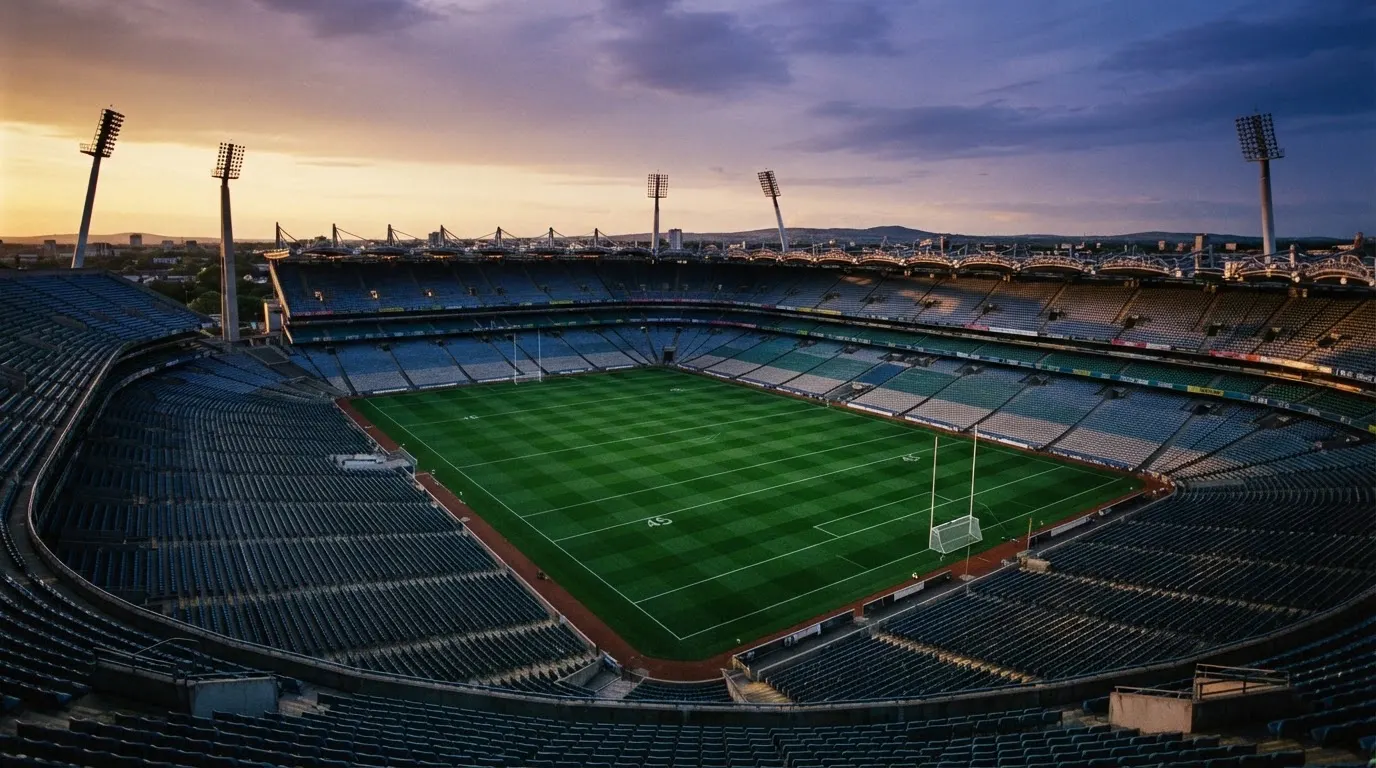
The game itself is unusual enough to be worth sketching. Each team fields 15 players with up to 15 substitutes of whom six may be used in a senior inter-county match. The ball can be carried for four steps before it must be bounced or soloed (toe-tapped) and can be kicked or hand-passed but never thrown. Senior matches last 70 minutes, two 35-minute halves; most adult club matches are 60. The pitch is a rectangle 130 to 145 metres long and 80 to 90 metres wide, the largest of any field sport. A goal — ball under the crossbar into the net — is worth three points; a point — ball over the crossbar — is worth one. Shots from outside the new 40-metre arc are worth two points under the 2025 rule changes, which lengthens the scoring range and changes how a totals market sits.
The 40-metre arc is the single rule change that has shifted the market the most in the last two years. A shot from outside the arc is now worth two points, so a forward shooting from distance scores a point that counts as two on the scoreboard. The totals market sits higher than it did before 2025 on most fixtures. A bookmaker that has not updated his lines for the new arc is offering prices that no longer reflect the sport, and a punter taking those lines is paying for a stale model.
A draw is replayed rather than extra-time resolved at senior inter-county championship level, which makes a three-way 1X2 market useless on a knockout fixture: the only two outcomes in the betting are the home side and the away side, because the draw is not the final outcome. League games do settle on the day, so a 1X2 market is offered on Allianz League fixtures and not on All-Ireland knockout games. The shape of the market follows the shape of the fixture.
The gambling offer landscape across ten operators
The comparison table below sits beside ten operators reviewed in order of licence account number, which is the order in which the Gambling Commission registered them. A licence number is not a recommendation and an account number is not a ranking: it is an administrative sequence. What the table covers is the licence that authorises the operator to take bets from customers in Great Britain and the state of the operator’s own terms on a particular subject, expressed in the operator’s words.
The table is descriptive, not advisory. Every cell carries a specific from an operator’s terms page or from the Commission’s public register; gaps are real gaps rather than ignored ones, and a cell without a specific is marked with the article-language no-data marker rather than a default or a guess. A reader who acts on a particular cell takes the operator’s terms as published at the time he reads them, not the terms as the comparison summarised them on this page.
| Brand | Gambling Commission remote licence number and licence holder | what the operator’s own terms state on the key’s subject |
|---|---|---|
| Ladbrokes | 054743-R-330863-014 (Commission account 54743); LC International Limited | Sports betting app published by Entain Operations Limited, GB App Store rating 4.66 from 101,255 ratings; subject terms as published on the operator’s site |
| Paddy Power | 039439-R-319330-013 (Commission account 39439); PPB Counterparty Services Limited | Sports betting app published by Paddy Power PLC, covering football, horse racing, boxing, rugby, tennis, golf, darts, snooker and F1; subject terms as published on the operator’s site |
| DAZN Bet | 048756-R-327274-019 (Commission account 48756); DZBT Limited | Deposits start at £5 by debit card, Apple Pay, Paysafecard, Trustly and Skrill, and at £20 by PayPal, with no processing fees; subject terms as published on the operator’s site |
| BetUK | 039198-R-319450-029 (Commission account 39198); LeoVegas Gaming PLC | Sports welcome offer: deposit £10 or more and place a sports bet within 7 days of registering to receive four £10 free bets (two football accumulators of 4+ selections and two multiples of 2+), valid 7 days, with opt-in required; subject terms as published on the operator’s site |
| Sporting Index | 027343-R-308898-011 (Commission account 27343); Sporting Index Limited | Lets customers switch between fixed odds and spread betting, with in-play betting, Bet Builder for football, auto cash-out and Multi-Markets; subject terms as published on the operator’s site |
| BoyleSports | 039469-R-319383-025 (Commission account 39469); Boylesports Enterprise | Sports welcome offer for UK players is £20 in free bets when a £10 bet is placed (€30 in free bets for a €10 bet for Irish players); subject terms as published on the operator’s site |
| Lottoland | 038991-R-319408-020 (Commission account 38991); EU Lotto Limited | App combines casino, lottery betting, sports betting and scratchcards; licensed by the Gambling Commission for customers in Great Britain; subject terms as published on the operator’s site |
| Octobet | 062545-R-337248-006 (Commission account 62545); Octopus Game Limited | Sportsbook welcome offer: 50% back as a free bet up to £50, plus a £10 casino bonus for new customers; subject terms as published on the operator’s site |
| Kwiff | 044448-R-323408-017 (Commission account 44448); Eaton Gate Gaming Limited | Licensed by the UK Gambling Commission; described as a trademark operated by Spryme Ltd; app has a 17+ App Store age rating; subject terms as published on the operator’s site |
| Betboro | 044181-R-324363-007 (Commission account 44181); Webmedia Development N.V. | Sports welcome offer: 100% matched free bet of up to £25 on the first qualifying wager, requiring a debit card deposit of at least £10 and a first bet of £5 to £25 with at least three selections each at 3/5 (1.60) or higher; subject terms as published on the operator’s site |
The vertical axis on which the table sorts is the licence account number, which is not a marketing number — it is the number the Gambling Commission assigns when an operator is admitted to its register. Sorting by account number is the closest an external comparison can come to neutral: a smaller account number is not a more trustworthy brand, but it is the only sort that avoids ranking by house or by recency.
The horizontal axis splits the table in two halves. The first half is what the Commission itself publishes: the licence number and the licence holder, both of which are matters of public record and can be checked against the register in seconds. The second half is what each operator publishes about itself — the cell quotes that the operator’s terms page makes available. The cells across the second column carry the operator’s own framing, with the understanding that framing is the operator’s and not the Commission’s. Where the cell carries an offer, the offer is described as the operator describes it; the reader’s task is to read the offer’s terms, which the cell is a summary of, before claiming it.
How to use the comparison
The reader who wants to bet on Saturday’s All-Ireland semi-final has a different priority than the reader who wants a bookmaker that offers a wide outright menu for the Championship as a whole. The table is the same for both, but the row each picks is different. The Championship bettor who wants the widest fixtures menu will end up with the operators that have a serious investment in Gaelic games — generally the larger brands at the top of the list — while the bettor looking for a specific offer (a free bet, a price boost, an acca insurance product) will end up with the row that publishes that product. The choice is not on the table; the choice is what to do with the table.
The licence column is the most useful on the page. A bookmaker with a Commission account number is licensed; a bookmaker without one is not, and the page treats the two as different categories of business. A bookmaker whose licence covers remote general betting standard (real events) is licensed to take bets on real sporting events; a bookmaker whose licence covers only a casino or a lottery cannot legally take a sports bet from a GB customer, whatever its homepage claims. The Commission’s register is searchable by name and by domain, and a five-second check resolves the question the table answers in a single cell.
The offer column is the second-most useful and the most likely to drift. A welcome offer terms page is rewritten whenever a marketing team has a quiet Monday, and a quoted number today may be a quoted number of a different kind tomorrow. The cells above are what the operator described at the time the page was put together. The reader who decides on the basis of one of them checks the current terms before staking.
Working out which bookmaker suits which reader
A betting market has as many reader-profiles as the sport does. The bookmaker that wins the league outright is rarely the one that wins the four-leg accumulator on Saturday afternoon; the bookmaker that wins the casual Saturday bettor is rarely the one a sharp Championship-follower wants for the ante-post outright. The decision below sorts the ten operators by what each one does best, with the understanding that what each one does best is also what it is least likely to be cheapest at.
For the bettor who wants the widest fixtures menu across the Championship season, the larger brands at the top of the comparison carry more markets than the smaller brands further down. Gaelic football is a niche sport on a British licensed bookmaker, and the depth of the offering correlates with the operator’s overall scale: the brands that price 200 Premier League matches on a Saturday price 12 Championship fixtures on the same weekend, where the smaller operators price fewer. The user pays for that depth in higher margins on individual selections, but the user gets the depth.
For the bettor who wants the thinnest margin on a Gaelic football match winner, the comparison above is short. No operator publishes margin by sport on its own site, and the only reliable test is comparing two prices on the same fixture. The same fixture at 1.85 / 1.85 at one operator and 1.91 / 1.91 at the other leaves a measurable difference in the long-term cost of betting on the market. The bigger brands tend to quote tighter prices on main markets, but the rule is the rule of averages — the bigger operators are tighter on average, but any individual fixture can go either way.
For the bettor who values the cash-out product above everything else, the operators below with auto cash-out and partial cash-out are the relevant rows. Cash-out is offered as an in-app feature rather than as a market, and the cash-out price is the bookmaker’s price rather than the market’s. The reader pays for the convenience in a price that is typically below what the bet would return if it ran to settlement, and the reader gets to take a value with a phone in his hand rather than a betting slip on a Saturday evening.
For the bettor who wants spread betting on Gaelic football, the answer is specific: Sporting Index, the row that carries both a Gambling Commission licence for fixed odds and an FCA licence for spread betting. Spread bets on Championship matches settle on a published spread on a metric — supremacy, total points, the first-half line — and losses on a spread bet can exceed the deposit. The spread-betting model is a different product to fixed-odds, and the operator carries the same trade in two different shapes depending on which product the customer is using.
For the bettor who treats the welcome offer as the decision criterion, the rows that publish specific terms are the relevant ones. BetUK’s four £10 free bets split into two football accas and two multiples has different value to a reader than BoyleSports’ £20 free bets for a £10 opening bet, which has different value again than Octobet’s 50% back as a free bet up to £50 plus a £10 casino bonus. The value is in the terms: minimum odds on the qualifying bet, expiry of the free bet, eligible markets, whether the free-bet stake is returned with a win or only the profit. The page describes each as the operator describes it; the reader reads the cell, then reads the operator’s terms on the offer, before staking.
What none of the licensed operators on this page offer
Gaelic football is not offered with the depth of the Premier League, the Championship, or the Champions League on any of the ten operators above. The Championship is the prime time; the Allianz Leagues and the club championships are a thinner offering. A reader looking for a price on a county second team in a divisional league will not find one at any of these bookmakers, and the only available match is sometimes the broadcaster’s stream, the GAA’s own GAAGO platform, or the radio. The licensed bookmaker’s product does what it does; outside that, the bettor watches rather than bets.
Spread betting on Gaelic football is licensed at one operator on this page, and not at the rest. The punter who wants a spread product on a Championship match reads Sporting Index’s terms and the spread-betting-specific terms in the FCA-regulated business above. The punter who wants a spread product and finds only fixed-odds markets at the licensed brand was looking for a product the licensed brand does not sell.
Betting exchanges with depth on Gaelic football are a separate product. The exchange operator that carries a Championship match in running on a Saturday is the one that has bothered to take the position, and the depth varies day to day. The exchange customer lays a price he is willing to lose at, or backs a price he is willing to back at; the exchange matches the position and collects the commission.
Inside the regulator: Gambling Commission licensing in Great Britain
The legal frame around a bet on a Gaelic football match is the Gambling Act 2005, the Gambling (Licensing and Advertising) Act 2014, the Commission’s Licence Conditions and Codes of Practice and the Remote Technical Standards. The bookmaker at the other end of the bet needs a Commission licence wherever the operator is based, because the test is whether the operator is providing gambling facilities to customers in Great Britain. A Gibraltar, Malta, Curaçao or Isle of Man licence is not a substitute. Northern Ireland is outside the 2005 Act, so a GB licence does not regulate betting in Northern Ireland; the comparison above is for customers in Great Britain, who is what the licensed operators serve.
The Commission publishes its licence categories clearly: remote general betting standard (real events), remote general betting standard (virtual events), remote general betting limited, remote pool betting and remote betting intermediary (the licence for exchanges). Every operator on this comparison carries the first of these categories, which is the licence that authorises betting on real events. The licensable activity is the activity itself; there is no separate Commission licence for betting on Gaelic football as opposed to betting on football, and a remote general betting standard (real events) licence covers all real sporting events. The absence of a separate Gaelic football licence is a feature of the regime, not a gap.
Since 7 May 2019, the licensed operator has verified a customer’s name, address and date of birth before the customer can deposit, place a bet, or claim a free bet. A customer who has not been verified cannot transact, and the verification is not a one-off check. Source-of-funds questions at higher spend are normal under the money-laundering rules. The licensed route does not offer anonymous play; the unlicensed route does not offer Commission protection.
The minimum age is 18 across every licensed product. The Commission’s identity check is a check of age first and identity second, and a customer under 18 cannot get through it because the operator cannot legally transact with him. The age verification is the operational line under the licence condition, not a marketing line on the homepage.
General Betting Duty is the operator’s tax on gross profits, currently 15%. From 1 April 2027 a new remote betting rate of 25% applies within it; remote bets on UK horse racing, bets on self-service betting terminals in licensed premises, pool betting and in-person betting stay at 15%. The player pays no tax on betting winnings in Great Britain; the duty is the operator’s cost, not the customer’s. Whether operators pass the duty on through the price is not established and the page does not write that they do.
Financial spread betting as a different product
Spread betting on sporting indices — supremacy, total points, a metric per match — is a different product to fixed-odds betting, and it is regulated separately. The Financial Conduct Authority regulates the financial-spread product; the Gambling Commission regulates the fixed-odds product and the sports-spread product at the same operator. Losses on a spread bet can exceed the deposit; the FCA requires the operator to make that fact clear to the customer before opening the account. The two licences sit on different sides of the trading floor; the customer who wants spread betting on Gaelic football reads the FCA terms as well as the Commission’s and accepts the loss profile the FCA terms describe.
The financial vulnerability check is a separate regime. A licensed remote betting operator runs a public-record check (bankruptcy, county court judgments, similar registers) when a customer’s deposits minus withdrawals exceed £150 in a rolling 30 days, and the check has been in force since 28 February 2025. The check is a public-record check, not an income check, not a credit reference check. The financial risk assessments (sometimes called “affordability checks” in the press) have been announced in a staged plan from July 2026 with no start date and are not yet in force.
Deposit limits and the saga of Remote Technical Standards 12
Remote Technical Standards 12 require operators to offer a gross deposit limit on a fixed time frame. The first changes have applied since 31 October 2025; a second phase was postponed to 30 September 2026; whether the second phase is live is not established. There is no state-set deposit or loss ceiling for betting; the limits are the customer’s choice, and the licensed operator’s job is to surface them and let the customer set them. The bettor who wants a £50 weekly limit sets one; the bettor who does not, does not. The state has not imposed a ceiling, and the licensed operator has not been given one to enforce.
Advertising: who can be in the ad and what the offer must say
The advertising rules that apply to betting offers in Great Britain are the CAP Code (non-broadcast) and BCAP Code (broadcast), both enforced by the ASA, sitting alongside the Commission’s own LCCP marketing conditions. CAP Code section 16 says marketing must be socially responsible and must not appeal strongly to under-18s; no one who is or appears to be under 25 may appear gambling in marketing or play a significant role, with an exception for marketing placed where the bet can be made directly. The rule is about who may appear in the ad, not who may bet.
Bonus and promotion terms are capped: wagering requirements on bonuses are capped at 10x (a £10 bonus at 50x wagering — £500 of bets required — would be banned), and mixed-product promotions are banned (an offer that requires gambling on two or more product types — bet on football to get free spins, for example — is no longer permitted). The exact threshold for the offer described above, and the date the cap took effect, are in the section earlier on this page. Whether the cap applies to free bets with no wagering condition, and any cap on the money value of a bonus, are not established and the page does not write them as established.
“Whistle-to-whistle” is an industry code rather than a statute. Betting advertisements are not shown on TV from five minutes before a live sporting event to five minutes after it, before the 9pm watershed (horse and greyhound racing excluded); the rule has applied since 1 August 2019. The Premier League clubs’ withdrawal of gambling sponsorship from the front of matchday shirts (from 2026/27; sleeves and hoardings remain) is a voluntary code from the clubs and not a legal cap. The state-mandated broadcasts ban remains on the broadcaster’s side.
What an unlicensed site lacks
A site that is not on the Commission’s register, whatever its homepage claims, does not carry GAMSTOP coverage, does not carry a Commission complaints route, does not carry an approved alternative-dispute-resolution body, does not carry the 10x bonus cap, does not carry the £150 vulnerability check, and does not carry a route to a British redress mechanism if the operator withholds funds. The customer who uses an unlicensed site takes the price the unlicensed site offers and surrenders the protections the licensed regime gives; the customer is not committing an offence by betting on an unlicensed site, and the book is not automatically “legal to use” for that reason. The risk is operational, not criminal: a customer whose funds are held by an unlicensed operator has fewer routes to recovery than the same customer with a licensed operator.
ISP-level DNS blocking has not been put in operation. The Commission’s enforcement is cease-and-desist notices, search-engine referrals, work with registrars and hosts, work with payment providers, and court-order DNS blocking powers when granted. The page does not write that any particular site is “blocked by ISPs” because none are, in general; the page writes that the licensed site is licensed and the unlicensed site is not, and the reader acts on that distinction.
Safer gambling, GAMSTOP and the bettor’s controls
GAMSTOP is the national multi-operator online self-exclusion scheme. It has been a mandatory licence condition for online operators since 31 March 2020 and covers every licensed brand on the comparison above: a customer who registers with GAMSTOP cannot open an account at any of them. The exclusion periods are six months, one year, five years, or five years with auto-renewal; after the minimum period, the exclusion stays in place for a further seven years unless the customer asks GAMSTOP to remove it. GAMSTOP covers online sites and apps; betting shops use a separate self-exclusion service. The licensed operator runs GAMSTOP at the registration gate: the new customer’s details are checked against the GAMSTOP database and the account is refused if the customer is on the register.
A customer who wants to manage his own play without GAMSTOP has the deposit-limit and timeout tools the licensed operator publishes. A deposit limit is set by the customer on the operator’s site, with a minimum period before any increase takes effect and a confirmation step. A time-out is a temporary exclusion the customer sets himself, with the same period structure. The licensed operator does not set the limits; the licensed operator offers the limit-setting tools and lets the customer choose.
The financial vulnerability check, in force since 28 February 2025 and described earlier in the regulator section, applies when a customer’s deposits minus withdrawals exceed £150 in a rolling 30 days. The check is a public-record check, not an income or credit reference check; the licensed operator runs it without telling the customer why and acts on the result according to its own policies. The financial risk assessments have been announced in a staged plan with no start date; the page does not write that they are in force.
The help services that sit alongside the licensed operator are GAMSTOP itself, GamCare (which runs the National Gambling Helpline), GambleAware (the funder of research, treatment and education), NHS gambling clinics (in-person treatment for problem gambling in NHS settings), and Gamblers Anonymous (the mutual-help fellowship). A customer who recognises his own pattern in the question prompts at the licensed operator can use any of these directly; the licensed operator’s safer-gambling pages link to them. The licensed operator’s relationship with these services is a referral, not a primary-care role; the customer who rings the helpline gets a trained response, not a sales call back.
The credit-card ban since 14 April 2020 means a customer cannot fund a betting account with a credit card, including via an e-wallet that was itself funded by a credit card. Debit cards and bank-based payments are not covered by the ban. A customer using a credit card for gambling in any form is using an unauthorised payment method at the licensed operator’s site and the licensed operator blocks it.
What the customer sets himself
The deposit limit is the customer’s number, on the customer’s terms. The licensed operator surfaces the limit-setting tools on the account page; the customer picks the limit (typically daily, weekly or monthly), confirms it, and the operator applies it. Decreases take effect immediately; increases are subject to a minimum delay period (typically 24 hours for a small increase, up to seven days for a larger one) and a re-confirmation step. The licensed operator may impose its own limits on top, but the state-set deposit limit stays as the customer chose it.
A reality check on the licensed site is a pop-up that appears at chosen intervals — every 30 minutes, every 60 — telling the customer how long he has been on the site and what his net position is. The customer can stop play at the reality check or continue; the licensed operator is not required to enforce either choice, only to surface it. The reality check is a sight-line, not a brake.
A time-out is a temporary exclusion, with options typically ranging from 24 hours to six weeks. A time-out is the customer’s tool; the licensed operator does not impose it without a request. A longer exclusion is GAMSTOP, which covers every licensed operator and a longer minimum period.
Crypto, payment methods and the question of anonymity
A licensed bookmaker in Great Britain does not offer anonymous play. The identity check before the first deposit, the source-of-funds checks at higher spend, and the credit-card ban together take anonymity off the menu at every licensed site. A customer who wants to bet without a check is using an unlicensed site; the licensed site checks, the unlicensed site does not.
The list of payment methods at a licensed site is set by the operator and varies by operator, but no state-set list of permitted methods exists. Debit cards, bank transfers, e-wallets (with the credit-card-funding rule above), and bank-based payment schemes (the Trustly-class products) are typical. Cryptocurrency as a deposit method is not specifically regulated for or against in the Commission’s published rules; the operator decides whether to take it. None of the operators on this comparison page is described as taking cryptocurrency at the licensed product, and the only sure test is the operator’s own deposit page.
DAZN Bet, which appears in the comparison above, deposits from £5 by debit card, Apple Pay, Paysafecard, Trustly and Skrill, and from £20 by PayPal, with no processing fees. The starting deposit is low for the card-based methods and higher for PayPal; the difference is the cost of the PayPal rail and is not unusual. The other operators on the page have their own minimum deposit figures that the comparison does not detail, and the reader checks the operator’s deposit page before staking.
The licensed site does not advertise the payment method as a feature; the licensed site presents it as a practical option. The unlicensed site that advertises cryptocurrency deposits and “no KYC” is making a marketing claim that the licensed site does not, and the licensed site’s identity check is the operational reality behind the difference.
What the customer checks himself
A customer who wants to know whether a particular payment method is accepted at a particular licensed operator opens the operator’s deposit page and looks. A customer who wants to know whether the operator’s deposit practice will accept a particular method opens the help pages and reads. A customer who wants to know whether a particular method is fast at a particular operator reads the help pages and reads the customer reviews; the licensed operator does not promise speed on deposits as a marketing line, and the speed is what the operational system delivers.
Bonuses, free bets and what the offer actually changes
The welcome offer is the centre of most licensed operators’ marketing and the centre of most licensed operators’ terms. The page above quotes each operator’s offer in the comparison’s offer column, and the rest of this section is what the offer actually does — and what the offer actually costs.
A “free bet” is not a refund in money and not a stake-paid-back win. The free bet lands in the customer’s account as a credit; the customer picks a selection, places the free bet on it; if the selection wins, the customer is paid the profit (decimal odds minus one multiplied by the free bet), not the profit plus the free-bet stake. A free bet worth £10 at odds of 6.00 pays the customer £50 of profit on a win, not £60. The free bet’s stake is forfeit, which is why a free bet at higher odds is worth more than a free bet at lower odds: higher odds mean higher profit, and the profit is the only part paid back.
A wagering requirement is the number of times the bonus (or the bonus plus the deposit) must be turned over in qualifying bets before the bonus and any winnings from it can be withdrawn. A £10 bonus with a 10x wagering requirement needs £100 of qualifying bets; a £10 bonus with a 5x requirement needs £50; a £10 bonus with no wagering requirement is paid back in money, not free bets. The Commission’s cap on the wagering requirement is 10x; an offer that requires more is offered under an unlicensed brand, not on the licensed side.
The minimum price for a qualifying bet is the floor below which the customer’s bet does not count toward the wagering requirement. A minimum price of 1.60 means a single at odds of 1.50 contributes nothing; a minimum price of 2.00 means only accumulator legs or longer-price singles qualify. The minimum price is the bookmaker’s tool to push the customer into less probable bets and is the rule that makes a low-odds wagering strategy impossible. The minimum price is also the rule that turns a wagering requirement into a margin calculation the customer is running on the bookmaker’s behalf.
The expiry of a free bet or a bonus is the deadline by which the offer must be used or the balance is forfeit. Free bets typically expire in 7 days; bonuses typically expire in 30. A customer who takes an offer and does not use it by the deadline loses the balance. The deadline is the bookmaker’s protection against the customer accepting an offer and never betting with it.
A “bet boost” is a price uplift on a particular selection, with a maximum stake that the boost applies to. The boost is a marketing line, not a margin change: the customer still pays the same margin on the unboosted parts of the slip and earns the boost only on the boosted selection. A boost on the win leg of a four-leg acca becomes a small additional return on the acca if it wins; the customer has not changed the price of the other legs.
A “risk-free” bet is a marketing term and not a contract term. A “risk-free” first bet that returns the stake as a free bet if it loses is not a refund in money — it is a free bet with the same wagering requirement as any other free bet. The “risk-free” wording is the bookmaker’s marketing; the contract is the free bet, and the customer’s cost is the same as if the offer had been named a free bet from the start. The page writes “risk-free” only where an operator uses the term, and the operator’s terms page carries the rest.
A “matched” bonus that requires a deposit to release is a deposit-gated offer: the customer must deposit and stake his own money first, then receives a bonus equal to some percentage of the deposit up to a cap. A 100% matched bonus up to £25 means a £25 deposit triggers a £25 bonus; a £50 deposit does not trigger a £50 bonus because the bonus is capped at £25. The bonus is paid as a free bet or as a credit subject to a wagering requirement, and the form the bonus takes is the form the operator’s terms describe.
What the offer really does at the four operators whose terms the page quotes
BetUK’s four £10 free bets (two football accumulators of 4+ selections and two multiples of 2+) for a £10 deposit and a sports bet within 7 days of registering, with opt-in required, is the most structured offer in the comparison. The customer splits the £40 of free-bet credit across the four named shapes; the bonus is paid in free-bet form rather than cash; the deadline is 7 days; the qualifying bet requires the customer’s stake on a sports market with his own money. The four-leg and two-leg shapes force the customer into specific accumulator structures, which carry higher margins than singles; the offer is generous on the headline and tighter on the structure.
BoyleSports’ £20 in free bets for a £10 bet (€30 in free bets for a €10 bet for Irish customers) is the simplest offer in the comparison: the customer places a £10 opening bet with his own money, receives £20 of free-bet credit if the opening bet settles (win or lose), and uses the credit on the operator’s chosen markets. The £20 is paid as free bets with the operator’s standard wagering requirement; the customer reads the operator’s free-bet terms before staking.
Octobet’s 50% back as a free bet up to £50, plus a £10 casino bonus for new customers, is the most generous-looking offer in the comparison and the most generous-looking offer that requires reading. The 50% back means a £100 opening bet loses and returns £50 in free bets, capped at £50 of free bets; the £10 casino bonus is a separate credit on the casino side of the business. The £10 casino bonus is a separate offer on a product with its own promotional rules, and the gaming-licence-side terms apply separately from the betting-licence-side ones.
Betboro’s 100% matched free bet of up to £25 on the first qualifying wager, requiring a debit card deposit of at least £10 and a first bet of £5 to £25 with at least three selections each at 3/5 (1.60) or higher, is the most tightly-specified offer in the comparison. The customer must deposit by debit card (no e-wallet, no bank transfer at the deposit stage); the first bet must be a multi-selection accumulator; each selection must be at 1.60 or higher; the customer’s free-bet credit matches his opening stake up to £25. The Betboro offer is the offering where the qualifying terms do most of the work, and the customer’s task is to read the selection list before he places the qualifying bet.
The mathematics of a free bet
A free bet worth £10 at odds of 6.00 returns £50 of profit on a win — decimal odds minus one multiplied by the free bet value, with the original £10 stake forfeit. The free bet is worth £10 in the account but pays out the profit only; the value at lower odds is lower, and the value at very high odds is close to the full £10 because the £10 stake is a smaller share of the return. A £10 free bet at decimal odds of 1.50 returns £5 of profit; a £10 free bet at decimal odds of 100.00 returns £990 of profit. The free bet is the same £10 in the account; the value the customer gets from it depends entirely on the decimal odds he picks.
The expected value of the free bet, ignoring the bookmaker’s margin and the operator’s selection rules, is the decimal odds minus one divided by the decimal odds, multiplied by the free bet value, all multiplied by the payout share of the market the customer uses. A £10 free bet at 1.80 on a market with a 95% payout share has an expected value of £10 × (1.80 − 1) / 1.80 × 0.95, or about £4.21. The expected value is an average across many bets and many outcomes; no single bet will pay £4.21, and a single bet will either pay nothing (if it loses) or pay the full profit on a win. The expected value is what a sharp customer compares across free bets: a free bet at 6.00 on the same 95% payout market returns £10 × (6.00 − 1) / 6.00 × 0.95, or about £7.92, almost double the value at 1.80. The free bet at high odds is the more valuable free bet.
The expected value multiplied by the probability the customer can find a market at the price the bookmaker allows (the wagering terms apply, the free bet cannot be split across ten singles at the floor of 1.60) is what the actual value of the offer looks like. The customer who picks the highest-price eligible market for his free bet extracts the most value; the customer who uses the free bet at the lowest eligible price extracts the least. The difference is real and is worth the half-hour of looking.
Live betting on Gaelic football and the cash-out product
Live betting on a Gaelic football match is the licensed operator’s live offering on the sport. The flow of the game is point-and-goal rather than goal-and-celebration, so the in-running book has to be priced on small scoreboard moves and short suspensions between scores. A licensed operator with a live product will suspend the market at the moment of a score, reopen it at a price that reflects the new score, and let the punter bet into the new market. A licensed operator without a live product will show the match as a fixture on the day but will not offer an in-running book.
The cash-out product is the licensed operator’s offer to close a bet before settlement. The cash-out value is the licensed operator’s price, not the market’s; the cash-out price is set to make sense for the licensed operator first and the punter second, and the published offer on a winning accumulator is typically worth less than the expected value of letting the bet run. Cash-out is useful for trimming risk on a four-leg acca when one leg is misbehaving; it is expensive when used to lock in small profits on a bet that would otherwise win.
Partial cash-out takes a slice of the bet’s cash-out value rather than the whole bet, leaving the rest to run. Partial cash-out is offered by some operators and not by others; the operator’s in-app features list is the test. Auto cash-out, offered at one operator on the comparison above, sets a target cash-out value in advance and closes the bet automatically when the offer reaches it. Auto cash-out removes the moment-of-decision problem on a phone screen that is updating.
Midnite’s app shows in-play events, an acca builder, popular accas and price boosts with maximum-stake limits, and the in-play product is the centre of the offering. The licensed product pages describe the in-play offering at each operator in their own words; the comparison above carries the descriptions where the page has them; the reader who wants to know what the licensed operator does in play on a Gaelic football match reads the licensed operator’s in-play page on the day.
What a live product on Gaelic football really shows
The live markets on a Gaelic football match are typically the winner, the handicap and the totals markets, with the proposition markets (first goalscorer, total points in the first half) offered on the bigger matches only. The pricing is point-by-point, with the market suspended at the moment of a score and reopened a beat later. The licensed operator’s margin in the live book is typically higher than the margin pre-match because the live book runs on less liquidity and the licensed operator is taking more risk per bet; the punter pays more for the live product than for the same selection pre-match. A bettor’s decision to take a Champions League quarter-final in running at a 6% margin or pre-match at a 4% margin is a real cost-of-entry decision; the live product is the price of being in the bet at the live moment.
The price of being in the bet at the live moment also means the price of missing it when the moment passes. A licensed operator with a faster in-running book (shorter suspensions, faster price updates) is offering a more usable live product, but a faster book is also a more expensive book for the licensed operator to run. The licensed operator’s investment in the live product correlates with his overall scale, and the larger brands tend to offer tighter live books in low-liquidity sports; the smaller brands tend to offer slower live books or no live book at all on Gaelic football.
Betting tips and the supposed predictors
The market for Gaelic football betting tips is run on the same shape as the market for soccer tips. A tipster publishes a price for a Championship match; the punter reads the tip and decides whether to back it. The tip may be free, behind a paywall, or part of a subscription service. The tip may reference form, injuries, head-to-head record, weather, venue, or a “feeling”. The tip is not a bet: the punter who takes it bets at his own price, his own stake, his own terms.
A tipster’s record is the published number that distinguishes a good tipster from a poor one. The record is the number of winning tips as a percentage of total tips over a published period. The record is one number; the number that tells the punter whether the tipster is worth following is the same number adjusted for the average price of the tipster’s selections. A tipster with a 55% win-rate at average odds of 1.80 (implied probability 56%) is breaking even after margin; a tipster with a 55% win-rate at average odds of 2.20 (implied probability 45%) is making 21% on turnover before the tipster’s fee. The record and the price are the two figures; a tipster who publishes one and not the other is showing the punter half the truth.
A punter who takes a tip pays the tipster’s fee and the bookmaker’s margin. The tipster’s fee is the subscription or the per-tip price; the bookmaker’s margin is the implied probability of the price minus the punter’s win-rate on the tip at that price. A subscription of £50 a month for ten tips at average odds of 2.50 is the punter paying £5 per tip; the punter’s expected profit depends on the tipster’s record, and the punter’s expected loss if the tipster is break-even after margin is the £50 a month.
The most useful tip is the one a punter can verify. A tip that names the team, the price, the bookmaker and the stake can be checked after the match; a tip that names the team and “best odds” cannot. A subscription service that names the team, the price and the bookmaker is the subscription service the punter can audit; a subscription service that names the team only is the subscription service the punter has to take on faith. The page does not endorse any particular tipster and does not carry any tipster’s tip; the page writes that the tipster market exists, what it costs and what an honest subscription looks like.
The bankroll question
A bankroll is the pot of money the punter has set aside for betting, separate from the rest of his finances. The bankroll is the limit on what the punter can lose; the punter’s task is to size his bets relative to the bankroll so that a losing streak does not put him out of the market. A unit is typically 1% to 5% of the bankroll; a punter with a £1,000 bankroll stakes £10 to £50 per bet at one unit. A punter who stakes more than one unit on a single bet is treating his bankroll as bigger than it is and is on a path to a £0 bankroll faster than the punter who reads the bankroll and stakes within it.
The bankroll is the discipline the punter adds to a market the bookmaker has set up against him. The bookmaker has a margin; the punter has a stake; the punter’s edge, if any, is in the punter’s ability to find prices the bookmaker has priced loosely. A punter with a real edge finds loose prices, bets his one-unit stake at the loose price, and lets the edge accumulate. A punter without a real edge bets his one-unit stake at the marginal price the bookmaker is offering and loses his one unit to the margin over time.
The punter’s discipline is harder than the bookmaker’s pricing. The bookmaker runs a model, prices markets, and lets the bets come in; the punter is his own bookmaker, his own model, his own bankroll manager, and his own regulator. A punter who treats the bankroll as an expense rather than an investment accepts that the long-term expected value is against him and pays for the entertainment of the bet in the gap. A punter who treats the bankroll as an investment is looking for an edge the bookmaker has not priced and is doing the work the bookmaker has done with a thousand times the data; the punter is at a structural disadvantage that no bankroll discipline closes.
The verdict on each bookmaker
Ladbrokes carries the Commission’s remote licence 054743-R-330863-014 under LC International Limited. The Ladbrokes Sports Betting App is published by Entain Operations Limited and is rated 4.66 from 101,255 ratings in the GB App Store. The brand is the largest on the comparison by GB App Store ratings, and the customer base is broad. Ladbrokes suits the bettor who wants a high-traffic bookmaker with a deep Championship fixture menu, and the customer’s cost is the typical large-bookmaker margin on individual Gaelic football markets.
Paddy Power carries the Commission’s remote licence 039439-R-319330-013 under PPB Counterparty Services Limited. The Paddy Power Sports Betting app covers football, horse racing, boxing, rugby, tennis, golf, darts, snooker and F1. The brand’s marketing has historically leaned on price boosts and money-back specials in the British and Irish markets. Paddy Power suits the bettor who wants a price-boost-led product across a wide fixture menu, with the same large-bookmaker margin profile.
DAZN Bet carries the Commission’s remote licence 048756-R-327274-019 under DZBT Limited. DAZN Bet deposits start at £5 by debit card, Apple Pay, Paysafecard, Trustly and Skrill, and at £20 by PayPal, with no processing fees. The low starting deposit on the card-based rails is the cheapest entry point on the comparison. DAZN Bet suits the bettor who wants a low-deposit entry to a licensed bookmaker, with a smaller fixture menu than the two larger brands above.
BetUK carries the Commission’s remote licence 039198-R-319450-029 under LeoVegas Gaming PLC. BetUK’s sports welcome offer is four £10 free bets (two football accumulators of 4+ selections and two multiples of 2+) for a £10 deposit and a sports bet within 7 days of registering, with opt-in required. The structured free-bet offer is the most segmented in the comparison. BetUK suits the bettor who plans to use the welcome offer on accumulator-style bets and reads the qualifying terms before staking; the offer is generous on the headline and tight on the structure.
Sporting Index carries the Commission’s remote licence 027343-R-308898-011 under Sporting Index Limited. Sporting Index lets customers switch between fixed odds and spread betting, with in-play betting, Bet Builder for football, auto cash-out and Multi-Markets. The unique product on this comparison is the spread betting on Gaelic football. Sporting Index suits the bettor who wants spread betting on a Championship match and accepts the loss profile of spread bets, which is a different product from fixed-odds and not a substitute.
BoyleSports carries the Commission’s remote licence 039469-R-319383-025 under Boylesports Enterprise. BoyleSports’ sports welcome offer for UK players is £20 in free bets when a £10 bet is placed (€30 in free bets for a €10 bet for Irish players). The offer is the simplest free-bet offer in the comparison. BoyleSports suits the bettor who wants a clean free-bet offer with no accumulator structure imposed on the free-bet credit, with the trade-off of a smaller product menu than the larger brands above.
Lottoland carries the Commission’s remote licence 038991-R-319408-020 under EU Lotto Limited. The Lottoland UK app combines casino, lottery betting, sports betting and scratchcards, and is licensed by the Gambling Commission for customers in Great Britain. The mixed-product focus means the sportsbook is one of several products on the same account. Lottoland suits the bettor who wants a single licensed site covering lottery, casino, scratchcards and sports, rather than a sports-first bookmaker.
Octobet carries the Commission’s remote licence 062545-R-337248-006 under Octopus Game Limited. The Octobet sportsbook welcome offer is 50% back as a free bet up to £50, plus a £10 casino bonus for new customers. The headline offer is the largest free-bet-credit ceiling in the comparison, on the condition the customer’s first bet loses. Octobet suits the bettor who wants the largest possible free-bet headline on a small first-bet loss, with the trade-off that the offer pays back only on a loss.
Kwiff carries the Commission’s remote licence 044448-R-323408-017 under Eaton Gate Gaming Limited. Kwiff is licensed by the UK Gambling Commission and describes itself as a trademark operated by Spryme Ltd; the app has a 17+ App Store age rating. Kwiff’s product is distinguished by the operator’s signature “supercharged” pricing on selected markets. Kwiff suits the bettor who values a sharp customer-experience feature over a wide fixture menu and is willing to operate inside Kwiff’s product rather than the broader market.
Betboro carries the Commission’s remote licence 044181-R-324363-007 under Webmedia Development N.V. The Betboro sports welcome offer is a 100% matched free bet of up to £25 on the first qualifying wager, requiring a debit card deposit of at least £10 and a first bet of £5 to £25 with at least three selections each at 3/5 (1.60) or higher. The qualifying terms are the strictest in the comparison. Betboro suits the bettor who plans to bet on a small accumulator at modest odds and is happy with debit-card funding only.
How the verdicts differ
Two verdicts across the comparison are unanimous: every brand is licensed to take bets from a GB customer, and every brand carries the Commission’s identity-verification regime. The remaining differences are on price, on fixture menu depth, on offer shape, and on product uniqueness.
The fixture menu depth declines down the table. Ladbrokes, Paddy Power and DAZN Bet — the larger, sports-first operators — carry Championship markets from May through July with a serious outright book; the smaller brands further down carry less. The bettor who wants the deepest Championship menu reads the three largest books first; the bettor who wants a simpler product reads the smaller books first.
The offer shape is widest at BetUK (four free bets), Betboro (matched free bet with strict terms), and BoyleSports (clean single-shape free bets). The bettor who wants a free bet on his opening stake and is happy to read terms reads the four operators whose terms the comparison carries; the bettor who wants a free bet headline and is not willing to read terms stays away from this page and walks past the offer.
The product uniqueness is Sporting Index’s spread betting on Gaelic football, which is the only such product in the comparison. The bettor who wants spread betting on a Championship match has one operator to read; the bettor who wants fixed-odds on the same match has ten.
What a reader does with the comparison
The comparison is a starting set, not a verdict. A reader acts on it by picking the row that matches his need and reading that row’s offer terms, then reading the operator’s own terms on the subject that brought him to the page, and then staking on the licensed operator he has chosen. The comparison does not say which row is “the best”; the comparison says what each row does, and the reader picks the row that matches his situation.
The first decision is whether the bettor wants fixed-odds or spread betting. Fixed-odds is offered by all ten operators; spread betting is offered by one. A bettor who wants spread betting on Gaelic football reads Sporting Index. A bettor who wants fixed-odds reads the other nine.
The second decision is whether the bettor wants the deepest Championship fixture menu (the larger brands) or a simpler product with a smaller menu (the smaller brands). The brand’s scale is not a guarantee of any individual price being tighter; the brand’s scale is a probability, not a certainty, that the fixture the bettor wants is on the menu.
The third decision is whether the bettor is planning to use a welcome offer or whether the bettor is funding an account without a bonus. The two are different products on the same operator: a bonus-funded account carries the wagering requirement; a non-bonus-funded account does not. The bettor who plans to use a welcome offer reads the terms before staking; the bettor who does not skip the terms page and accepts the offer is signing up to a contract he has not read.
The fourth decision is whether the bettor is willing to verify his identity before his first deposit or whether he would rather use an unlicensed site without verification. The licensed site verifies; the unlicensed site does not. The bettor who wants verification picks a row from the comparison; the bettor who wants anonymity does not, and accepts what that costs in protections.
Frequently asked questions
How does a bet on Gaelic football actually work?
The licensed bookmaker carries an outright market on the winner of a match, home or away. The punter picks a side, stakes a chosen amount, and receives a price the bookmaker has already published. A draw is offered in league fixtures and not in knockout games, where a tie is replayed. A winning bet pays back the stake plus the profit at the published decimal odds; a losing bet pays nothing. The first step is to open an account at a licensed bookmaker, verify identity, deposit and place the bet.
How can a customer check that a bookmaker holds a Gambling Commission licence?
The Commission’s public register is searchable by business name, trading name, domain or account number, and is the whole test. A bookmaker on the register is licensed; a bookmaker off the register is not licensed to take a GB bet, whatever its footer says. A licensed bookmaker with an offer on Gaelic football is shown on this page in the comparison table; a bookmaker not on the page is not on the comparison because the comparison covers licensed brands only.
How is a betting return worked out from stake and odds?
The decimal odds multiplied by the stake gives the gross return, which is the stake plus the profit. A £10 stake at decimal odds of 1.90 returns £19, of which £10 is the stake and £9 is the profit. A £10 stake at decimal odds of 6.00 returns £60, of which £10 is the stake and £50 is the profit. The conversion from fractional odds (5/1, 11/4) to decimal odds is one calculation: a divided by b plus one.
What is the bookmaker’s margin and how does it show in the odds?
The bookmaker’s margin is the share of every pound bet on a market that the bookmaker keeps, expressed as a percentage. On a two-way market with both sides priced at 1.90, the implied probabilities add to 105.3%, leaving about 5.3% margin. The same market at 1.95 each side has implied probabilities adding to 102.6%, leaving about 2.6% margin. The lower the sum of implied probabilities, the lower the margin, and the cheaper the market is for the punter to bet into over time.
How do fractional odds such as 5/1 convert to decimal odds such as 6.00?
Fractional odds express the profit per unit stake; decimal odds express the total return per unit stake. The conversion is a divided by b plus one. 5/1 (five-to-one) becomes 5 divided by 1 plus one, or 6.00. 11/4 (eleven-to-four) becomes 11 divided by 4 plus one, or 3.75. The two forms pay the same on the same selection; the difference is the presentation.
Which controls does a licensed bookmaker have to offer a customer?
A licensed bookmaker offers a deposit limit (daily, weekly or monthly), a time-out (24 hours to six weeks), a session reality check at the customer’s chosen interval, and GAMSTOP registration (six months to five years). The first three are the customer’s tools, set by the customer on the licensed operator’s site; GAMSTOP is the national multi-operator exclusion scheme that covers every licensed brand on this page. The licensed operator runs GAMSTOP at registration and refuses accounts to customers on the register.
Rugby, cricket & Gaelic – Newbookiesuk.com
Content created by the «Newbookiesuk.com» team
